

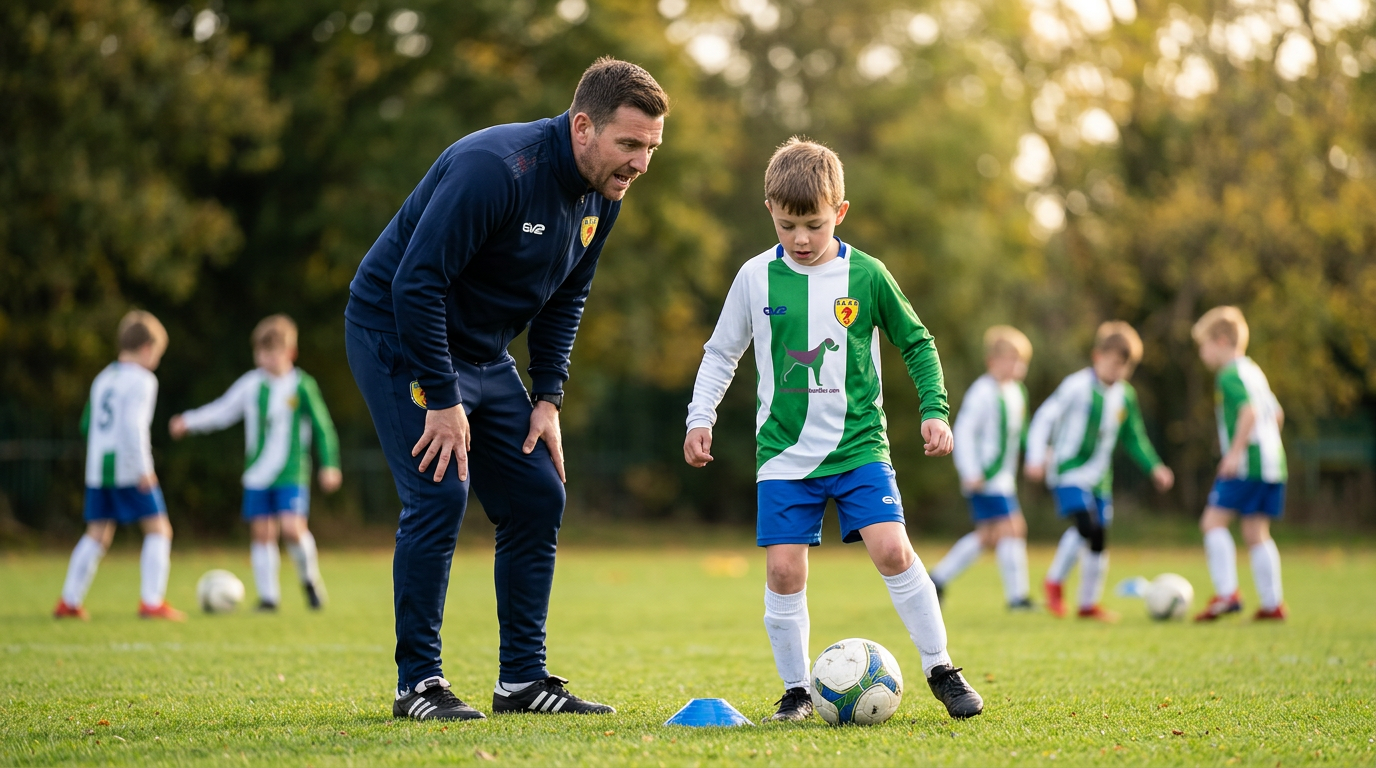

Sometimes the biggest improvement to a session comes from a small change in setup, not a brand new drill.
This article answers the practical, hands-on questions coaches ask most about structuring sessions — ideas you can use this week, in line with JBFC Football’s #LoveTheBall approach to keeping every player involved and improving.
One simple ball mastery game every age group should try this week
Ball mastery doesn’t need to be complicated to be effective. A simple “keep it moving” game — where the ball is never allowed to stop, anywhere in the space — builds touch and confidence at almost any age, with zero setup required. Try it for five minutes at the very start of your next session, and watch how much more comfortable players look on the ball for the rest of the practice.
Why small-sided games beat lining kids up for drills
Lining children up to take turns in a drill feels organised and easy to manage, but most of the group ends up simply standing around waiting. Small-sided games keep every player involved — making decisions and touching the ball constantly, which is where most real learning happens. Next session, try swapping one lined-up drill for a small-sided game working on the same skill: same lesson, far more involvement from every player.
A 5-minute rondo to build faster decision-making
Quick decision-making isn’t only about speed or athleticism. A simple rondo — keep-ball in a tight space under pressure — forces fast scanning, fast passing and fast thinking on almost every touch. Starting a session with just five minutes of rondo, before anything else, tends to sharpen focus and decision-making for the rest of the practice. It’s a small addition that pays off across the whole session.
How to coach 1v1s without overcomplicating it
Coaching 1v1s doesn’t need to be complicated. It’s tempting to load young players with multiple moves and footwork patterns all at once, but at grassroots level the real win is simple: the attacker tries to get past, the defender tries to stop them. Set up a simple 1v1 channel and let players try, fail, and try again — the moves tend to develop naturally through repetition, without needing to be taught directly.
One drill any player can do alone at home, no coach needed
Players often assume proper practice needs a session, an instructor, and equipment. Wall passing — controlling and returning a ball against any flat surface — builds first touch and both-footed control with nothing more than a ball and a wall. Encourage players to find a wall and spend ten minutes practising with both feet during the week; it’s a simple habit that makes a noticeable difference over time.
How to include every ability level in the very same drill
Running one version of a drill and hoping it suits both your strongest and developing players rarely works well. Adjusting space, time, or the target — rather than the activity itself — lets every player face the right level of challenge inside the exact same practice. Try giving your strongest player slightly less time or space, and your developing players a little more, within one shared drill rather than two separate ones.
Want more like this?
Good coaching isn’t about having all the answers on day one — it’s about reflecting, adapting, and putting players first, session after session.
At JBFC Football, our #LoveTheBall philosophy exists to help children fall in love with the game, at their own pace, in a pressure-free, inclusive environment.
Follow JBFC Football for more advice like this, and get in touch if your son or daughter would like to get involved in our Saturday Club sessions in Great Horkesley, Colchester, or learn in a more focused environment with us. #LoveTheBall