

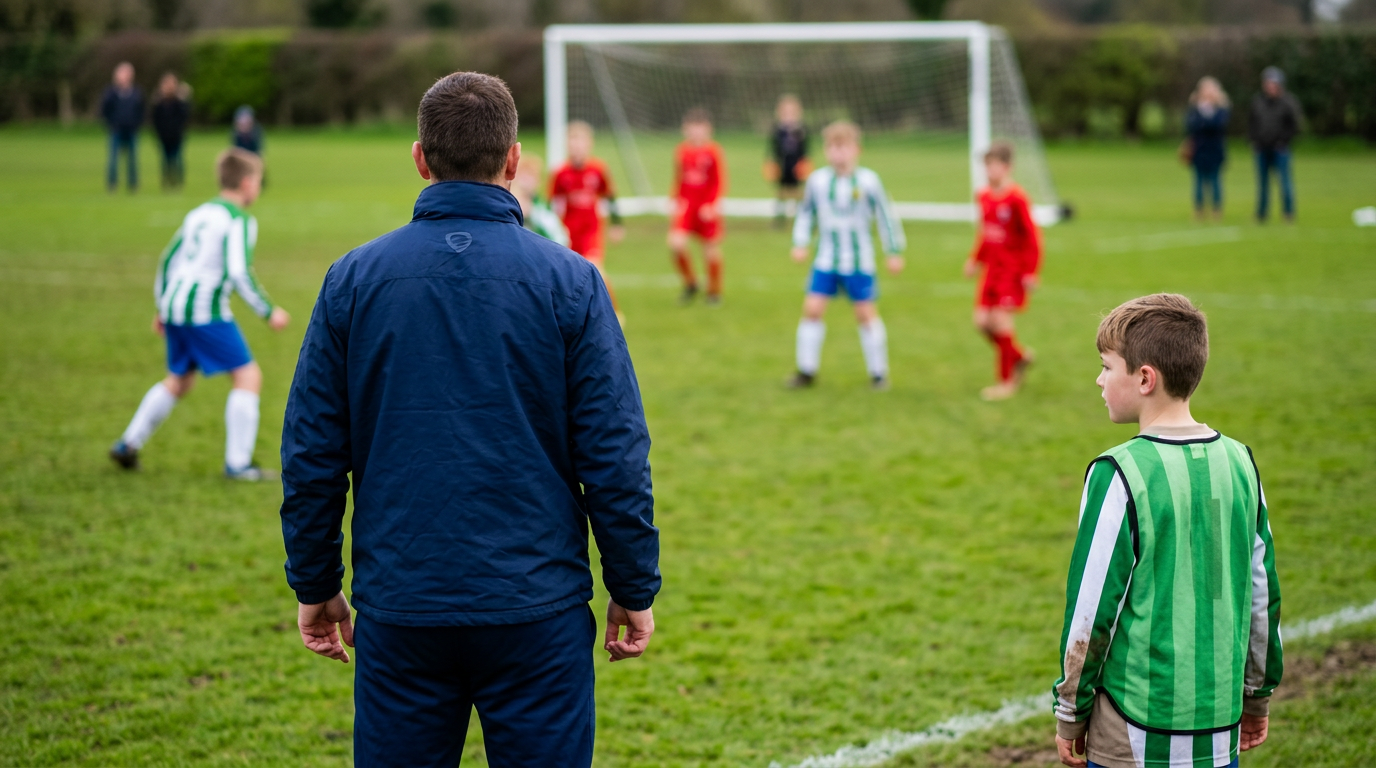

Grassroots coaching throws up the same dilemmas again and again, how much to instruct, how to handle tricky parent conversations, how to keep mixed-ability groups engaged.
This article answers the questions we hear most often from coaches, in line with JBFC Football’s #LoveTheBall philosophy: development and enjoyment first, with results following from that, not the other way round.
How much should you actually coach during a game?
Less than most coaches think. Constant instruction during a match feels like helping — it can feel like earning your place on the touchline — but players struggle to process instructions while under pressure on the ball. The coaching happens in training; matchday is the test, not the lesson. Try staying quiet for the first half of your next match and simply observe what your players do when nobody is telling them what to do.
How do I handle a parent who’s convinced their child should be playing more?
The instinct is often to get defensive or avoid the conversation entirely. A calm, honest conversation focused on what you’re working on with their child — rather than comparisons to other players — almost always lands better than silence. Lead with: “here’s what I’m seeing, and here’s what we’re working on.” Most parents simply want to feel heard, not necessarily to win the argument.
How do I deliver fair playing time when ability varies hugely?
It’s tempting to lean on your strongest players when a game is close, purely to get the result. At grassroots level, especially with younger age groups, development matters more than the scoreline — every player needs minutes to actually improve. Plan playing time before the match rather than during it, so the scoreline doesn’t quietly start influencing your substitutions once the game gets tight.
How do I keep a mixed-ability group all engaged in one session?
It’s easy to default to one version of a drill and hope it suits everyone. Small adjustments — a bit more space, an extra defender, a simplified target — let every player work at the right level of challenge inside the exact same practice. Next session, try building two versions of the challenge into one drill, rather than running two completely separate activities for different ability groups.
What’s the right way to talk to kids about losing?
How you discuss a loss matters more than the result itself. Dismissing it, or dwelling on what went wrong, are both tempting, but neither helps much. Children learn more from a calm, honest look at what they tried and what to try differently next time. After a loss, ask one question — “what’s one thing you’d try differently next time?” — and let that be the whole conversation.
How do I bring a shy or low-confidence child out of their shell?
A shy or low-confidence player rarely needs more instruction — they need more trust. Extra encouragement in front of the whole group can feel like a spotlight they didn’t ask for. What actually helps is often smaller and quieter: a private word, or a low-pressure task they’re likely to succeed at. Find one small task in this session you know they’ll succeed at, and let that success speak for itself.
What age should kids start learning real tactics and positions?
Later than many coaches assume. It’s tempting to introduce shape and formations as soon as children can kick a ball reasonably well, but without solid ball skills and confidence first, tactical ideas rarely stick. Around 8 or 9 is usually when tactical concepts genuinely start to land. With younger groups, keep things simple — ball mastery and fun first — and the tactics will make far more sense once that foundation is in place.
How do I become a better coach without spending a fortune on courses?
It’s easy to assume the next badge is what’s holding you back. In reality, watching other coaches, honestly reflecting on your own sessions, and simply asking your players what they enjoyed will teach you more, faster, and at no cost. After your next session, ask three players one question: “what was your favourite part today?” Their answers will teach you something useful almost every time.
How do I make training feel more realistic and game-like?
Lines of cones and isolated drills feel organised, but players rarely face decisions like that in a real match. Small-sided games, with a bit of pressure and a genuine decision to make, teach players far more than a perfectly drilled but predictable practice. Take one drill from your next session and add an opponent, even a passive one, and notice how much more it teaches your players about the real game.
How much technical work vs. game play should a session include?
It’s easy to lean heavily one way — all technical repetition, or all scrimmage with no real teaching woven in. The best sessions tend to blend both: a short technical focus, followed immediately by a game that puts that exact skill under real pressure. A simple structure works well: warm-up, one focused technical practice, then a small-sided game that uses it directly. Simple, and it tends to stick.
How do I coach without stopping practice every 30 seconds?
Correcting every mistake the moment it happens can feel productive, but constant stoppages interrupt the flow players actually need to learn through doing. A few well-timed interventions usually teach more than continuous interruption. Try picking just one or two coaching points for the whole practice, and let everything else play out uninterrupted — players often work things out for themselves more than coaches expect.
What actually makes players want to come back next season?
It’s rarely the trophy. Clubs often assume results and league position are what keep players coming back, but most players return because they had fun, made friends, and felt like they belonged — not because of where they finished in the table. At the end of this season, try asking your players directly what made them want to keep coming back. The answer is often simpler, and more human, than expected.
Want more like this?
Good coaching isn’t about having all the answers on day one — it’s about reflecting, adapting, and putting players first, session after session.
At JBFC Football, our #LoveTheBall philosophy exists to help children fall in love with the game, at their own pace, in a pressure-free, inclusive environment.
Follow JBFC Football for more advice like this, and get in touch if your son or daughter would like to get involved in our Saturday Club sessions in Great Horkesley, Colchester, or learn in a more focused environment with us. #LoveTheBall